
From Sign-Up Form to AI Plan Assistant
An AI cost-and-coverage assistant for a Medicare Advantage insurer.
Product Lead · Healthcare AI Medicare Advantage insurer Jan 2025 to May 2026 · Client work
A CEO asked me for a sign-up form to boost Medicare enrollment. I pitched an AI assistant that helps people choose the right plan first, and designed it to scale: it grew from a broker pilot into the insurer's physician tool and support CRM, expanding from 5 knowledge areas to 11 without a rebuild.
Challenge:
Picking a Medicare plan is the hard part of enrolling, and nobody could answer the questions it depends on quickly. Will my doctor be in-network? What will my medications cost? Brokers had to chase those answers across scattered formularies, directories, and PDFs, or text the Head of Sales directly. Slow answers meant slower enrollments and less confident members.
Results:
  • Pulled into two more products: physicians asked for it by name, and it was integrated into their point-of-care tool and the new support CRM.
  • Scaled without a rebuild: grew from 5 knowledge areas to 11, backed by about 20 live data tools.
  • Internal demand: client teams kept asking to roll it out to more brokers and build it into other tools.
  • Bet validated: six months of usage data showed cost and coverage are the top questions members and support reps ask.
  • Projected impact: 20,000+ broker hours saved a year and 10-20% fewer support calls at full rollout.
The assistant inside the insurer’s new support CRM, aware of the member on the call. (Prototype, rebranded.)
“The tool excels at clearly displaying benefit information, providing accurate copayments when queried.” VP of Sales
“I see the value in fewer back-and-forth calls and more self-service.” VP & Chief of Staff

‍

Approach:

The call

I recommended a cost-and-coverage assistant instead of the sign-up form the CEO asked for. He pictured a broker on a bus convincing a senior to join, then a quick text form to sign her up on the spot. But signing up is the last step. First, people need to know which plan fits their doctors, drugs, and budget, and a form can't tell them. So I proposed helping them find the right plan first, starting with brokers, who are already in those conversations. The CEO green-lit it after seeing the prototype.

I made a second, quieter call with my lead engineer: we'd build for reuse from day one. The PRD named physicians, members, and prospects as future users, and the architecture let us add knowledge areas without rebuilding. That decision is why the assistant could later move into other products.

One shared agent behind brokers, physicians, and member support, grounded in official plan data.

What I did

  • Reframed the CEO's request from a sign-up form into a plan-finding assistant, then prototyped it and got it green-lit.
  • Scoped what blocks a plan decision with the sales and broker teams: drug costs, in-network doctors, procedure costs, and extra benefits like OTC allowances and rewards.
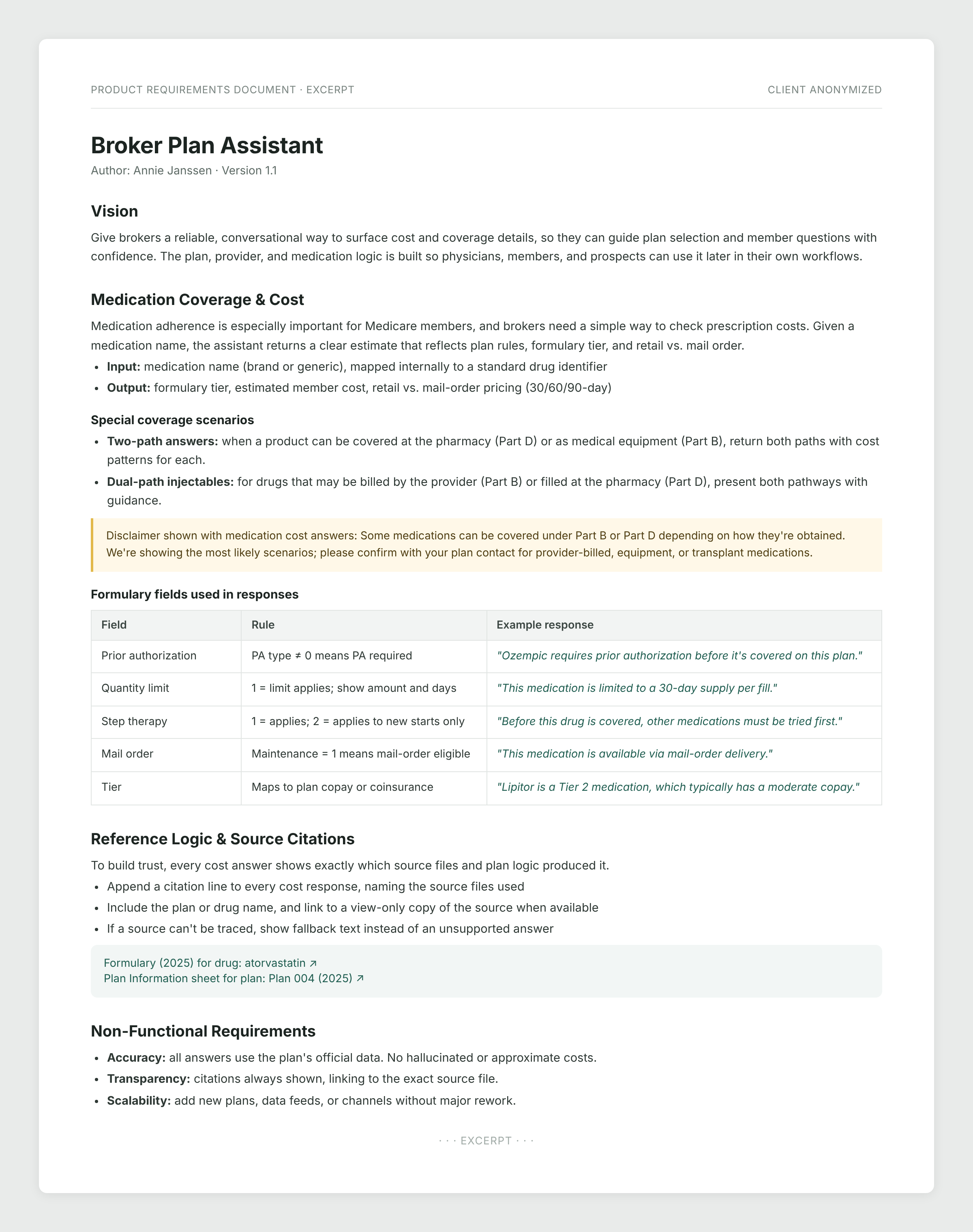
  • Wrote trust into the requirements: official data only, a source citation on every cost answer, strict topic guardrails, and a clear handoff to a human when the assistant isn't confident.
  • Built an evaluation framework with the client's QA team: regression tests on every deployment, scored against the insurer's accuracy bar.
  • Led the expansion into the insurer's physician-facing point-of-care tool and its new member support CRM, managing stakeholders across product, IT, pharmacy, and legal.

AI notes

  • Evaluation: test datasets built with the client's QA team, regression runs on every deployment, and failures sorted by cause: missing data, guardrail mismatches, or test misalignment.
  • Accuracy: answers come only from official plan, formulary, and provider data No estimated costs, and every answer cites its source file.
  • Human in the loop: low-confidence or out-of-scope questions go to the support team, and users rate answers with thumbs up or down.
  • Privacy: lookups never take a name or member ID, and sensitive fields are excluded at the query.
  • Success meant two things: clearing the accuracy bar, and teams asking to use it.
What I learned:

Compliance fear, not capability, paused the member-facing version. Next time I'd make verification proactive from the first prototype, with legal in the room and an LLM-as-judge scoring every answer for accuracy and compliance.

I turned that lesson into a white paper on where AI is creating an advantage in Medicare Advantage, and how plans can make verification proactive from the start.

Read “Proactive by Design” →

‍

Next Project

No items found.

What inspires me

Breathwork, poetry, British rap, The Artist’s Way, CrossFit, and baking treats for my dog, Diesel, fuel my inner artist, which feeds my product thinking.

The Short Version

Art kid turned marketing grad turned product leader. I build AI products that feel human, write white papers with a pulse, and lead my team through box breathing before big presentations.